
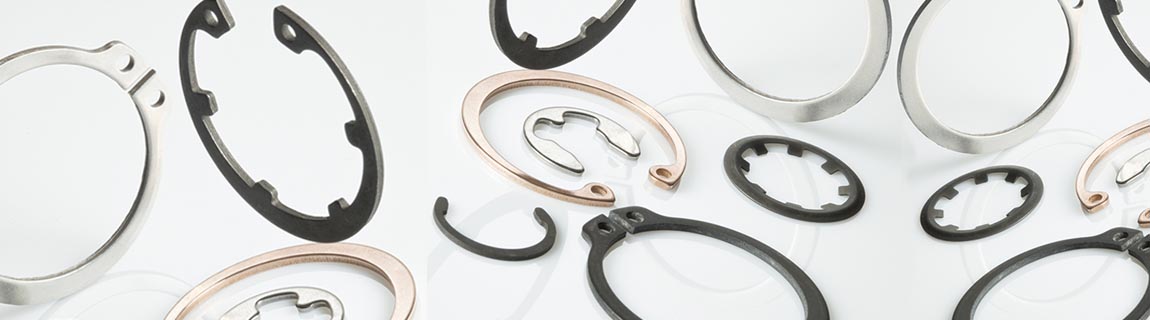
Retaining rings for axial assembly
Steel
DIN 471
ex UNI 3653-7435

They are the most used rings for shafts thanks to the advantages offered by the thickness and radial wall. They withstand high axial load and can also be used in applications with high RPM.
Rings TYPE AM for shaftsDIN 471
ex UNI 3653-7435 Stacked

Rings for shafts DIN 471 type A stacked for automatic assembly.
Rings TYPE J for boresDIN 472
ex UNI 3654-7437

They are the most used rings for bores thanks to the advantages offered by the thickness and radial wall. They withstand high axial load and can also be used in applications with high RPM.
Rings TYPE JM for boresDIN 472
ex UNI 3654-7437 Stacked

Rings for bores DIN 472 type J stacked for automatic assembly.
Rings TYPE NA for shaftsIn inches

They are the inch version of rings A mostly used in the American and English market.
Rings TYPE NJ for boresIn inches

They are the inch version of rings J mostly used in the American and English market.
Rings TYPE AV for shaftsConcentric

They have a smaller radial width than DIN 471 but provide a concentric contact surface for the thrust element. However the reduced section leads to a reduction in the permissible loads.
Rings TYPE JV for boresConcentric

They have a smaller radial width than DIN 472 but provide a concentric contact surface for the thrust element. However the reduced section leads to a reduction in the permissible loads.
Rings TYPE AK for shaftsDIN 983

They have several equally distributed lugs on their circumference which increase the contact surface for a better support than the DIN 471 rings in the presence of chamfers or roundings.
Rings TYPE JK for boresDIN 984

They have several equally distributed lugs on their circumference which increase the contact surface for a better support than the DIN 472 rings in the presence of chamfers or roundings.
Rings TYPE AS for shaftsDIN 471
ex UNI 7436 Heavy duty

They have a greater thickness than the DIN 471 rings and on a smaller sizes also greater radial wall. This makes them able to withstand to higher axial load.
Rings TYPE JS for boresDIN 472
ex UNI 7438 Heavy duty

They have a greater thickness than the DIN 472 rings and on a smaller sizes also greater radial wall. This makes them able to withstand to higher axial load.
Rings TYPE JSM for boresDIN 472
ex UNI 7438 Stacked

Rings DIN 472 type JS heavy duty for bores stacked for automatic assembly.
Rings TYPE NAS for shaftsHeavy duty

AS rings in american inches, used in the United States and Great Britain.
Zinc Plated
DIN 471
ex UNI 3653-7435

They are the most used rings for shafts thanks to the advantages offered by the thickness and radial wall. They withstand high axial load and can also be used in applications with high RPM.
Rings TYPE J for boresDIN 472
ex UNI 3654-7437

They are the most used rings for bores thanks to the advantages offered by the thickness and radial wall. They withstand high axial load and can also be used in applications with high RPM.
Stainless steel
DIN 471
ex UNI 3653-7435

They are the most used rings for shafts thanks to the advantages offered by the thickness and radial wall. They withstand high axial load and can also be used in applications with high RPM.
Rings TYPE J for boresDIN 472
ex UNI 3654-7437

They are the most used rings for bores thanks to the advantages offered by the thickness and radial wall. They withstand high axial load and can also be used in applications with high RPM.
Rings TYPE AV for shaftsConcentric

They have a smaller radial width than DIN 471 and DIN 472 but provide a concentric contact surface for the thrust element. However the reduced section leads to a reduction in the permissible loads.
Rings TYPE JV for boresConcentric

They have a smaller radial width than DIN 471 and DIN 472 but provide a concentric contact surface for the thrust element. However the reduced section leads to a reduction in the permissible loads.
Rings TYPE AK for shaftsDIN 983

They have several equally distributed lugs on their circumference which increase the contact surface for a better support than the DIN 471 and DIN 472 rings in the presence of chamfers or roundings.
Rings TYPE JK for boresDIN 984

They have several equally distributed lugs on their circumference which increase the contact surface for a better support than the DIN 471 and DIN 472 rings in the presence of chamfers or roundings.
Bronze
DIN 471
ex UNI 3653-7435

They are the most used rings for shafts thanks to the advantages offered by the thickness and radial wall. They withstand high axial load and can also be used in applications with high RPM.
Rings TYPE J for boresDIN 472
ex UNI 3654-7437

They are the most used rings for bores thanks to the advantages offered by the thickness and radial wall. They withstand high axial load and can also be used in applications with high RPM.